





Awareness of the Carbon Border Adjustment Mechanism
Contents |
[edit] What is the carbon border adjustment mechanism?
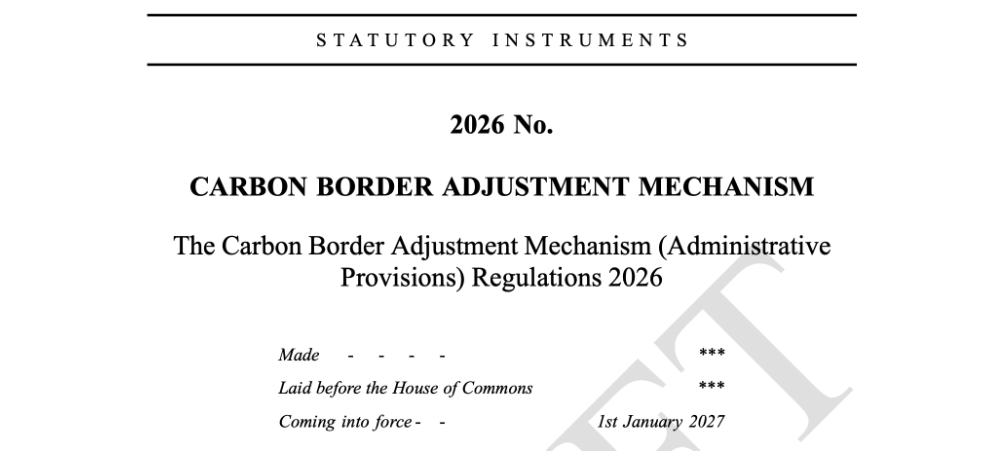
The carbon border adjustment mechanism (CBAM) is a new tax aiming to ensure that highly traded, carbon intensive goodswhich are imported into the UK face a comparable carbon price to that paid by manufacturers producing the same goods in the UK. In the UK, for direct emissions, manufacturers can be subject to carbon pricing under the UK Emissions TradingScheme (ETS). CBAM will apply from 1 January 2027 to goods from these industrial sectors: aluminium, cement, fertiliser, hydrogen, iron and steel.
[edit] What is the intention behind CBAM?
CBAM is intended to prevent carbon leakage by ensuring that domestic decarbonisation efforts lead to real global emissions reductions rather than shifting production abroad. Carbon leakage occurs when industries relocate to countries with weaker carbon pricing, increasing overall emissions. CBAM addresses this by applying a comparable carbon cost to imports of high emission goods, aligning them with the costs faced by UK producers under the UK Emissions Trading Scheme (ETS). By doing so, it protects the competitiveness of UK industry, encourages continued investment in low‑carbon production, and ensures a level playing field. The CBAM tax rates will be linked to UK ETS costs, adjusted to reflect any free allowances or discounts received by domestic producers.
[edit] Background to CBAM
Between 2023 and 2025 the UK developed CBAM through a staged series of consultations and enabling legislation. An initial consultation on “addressing carbon leakage risk to support decarbonisation” (March–June 2023) led to a December 2023 government response confirming that a UK CBAM would be introduced to tackle carbon leakage linked to domestic carbon pricing. A second (March–June 2024) "consultation on the introduction of a UK carbon border adjustment mechanism" then set out detailed design and administration proposals, with the October 2024 response confirming key scope decisions, including that glass and ceramics would not be in scope from commencement.
The Finance Act 2025 gave HMRC powers to prepare for CBAM and to obtain specified UK ETS information from HM Treasury and HMRC to support its design and operation. A technical consultation on the draft CBAM legislation (March–July 2025) refined the mechanics of the regime, including the frequency of accounting and payment and the data required in returns. As announced at Budget 2025, indirect emissions associated with CBAM goods will not be covered at the 1 January 2027 start date, reflecting continued support for the Energy Intensive Industries Compensation Scheme.
[edit] What to do about CBAM?
As the deadline slowly approaches for the introduction of the UK’s Carbon Border Adjustment Mechanism (CBAM), one of the largest independent VAT advisors in the country, has launched a comprehensive new service for businesses.
Known as the CBAM Compass – Helping Navigate the New Carbon Tax, this new service will provide user-friendly advice and explanation, set out in simple terms what CBAM is, the thinking behind it and how it will impact businesses as the new carbon tax system gets underway in the UK from 1 January 2027.
The CBAM Compass will keep clients up to speed through the use of various media, including regular video and written updates, ensuring they know what they need to know, when they need to know it and what actions they need to undertake now, as well as ‘horizon scanning’ what is coming next in this dynamic and novel area of the indirect tax landscape.
The Glasgow-based firm stresses that companies which engage at an early stage to understand the major cost implications of the new tax, which came into force within the EU on 1 January 2026, will lead the way and gain competitive advantage. And it points out that companies will be forced to ensure that emissions data is provided and verified to avoid swingeing financial and potentially reputational penalties.
VITA Partner Craig Stobo, who advises UK and international firms on CBAM readiness, said: “The CBAM Compass is designed to alert companies to the potential impact of the EU and the UK’s wide-ranging initiative to drive decarbonisation and promote less carbon intensive manufacturing. It is intended to encourage a proactive approach to managing the new tax, which will keep evolving, with more sectors being brought into its scope and reporting requirements set to become more stringent. The underlying concept of the new tax is that businesses be incentivised to find other, less carbon-intensive ways of creating their products, but there is no doubt whatsoever that, over time, it will involve less carrot and more stick and boardrooms must be prepared.”
CBAM is designed to put a price on the carbon emissions embedded in imported goods, initially targeting high-emission sectors such as steel, cement, and fertilisers. Its goal is to prevent “carbon leakage” and create a level playing field by aligning costs for imports with existing EU carbon pricing. The UK Government confirmed in its November 2025 Budget that it will press ahead with implementation of the new rules in 2027 but announced that the inclusion of indirect (Scope 2) emissions in the UK CBAM has been pushed back to 2029 or later.
Craig said: “the exclusion of Scope 2 emissions will reduce the amount of CBAM payable by importers at a time when the UK carbon price is widely expected to rise sharply due to alignment with the EU trading system and the phase-out of free allowances. In the first sign that the scope of the UK CBAM could widen over time, the Budget also revealed that the Government is exploring the feasibility of adding refined oil and fuel products to the CBAM in future. We are urging companies to begin data collection, supply-chain mapping, and emissions reporting preparations immediately, emphasising that professional guidance will be essential.”
This final section of this article was issued via press release as 'Carbon tax specialist sounds alert for businesses with launch of new service on Carbon Border Adjustment Mechanism' by Blueprint Media dated 17 March 2026. For further information about CBAM see Policy paper Carbon Border Adjustment Mechanism Published 26 November 2025
[edit] Related articles on Designing Buildings
- A zero-carbon UK by 2050?
- Black carbon.
- Blue carbon.
- Biogenic carbon.
- Biologic carbon sequestration.
- Carbon Border Adjustment Mechanism CBAM;
- Carbon capture.
- Carbon cycle.
- Carbon dioxide.
- Carbon emissions.
- Carbon intensity.
- Carbon intensive goods
- Carbon Price Support CPS
- Energy Intensive Industries Compensation Scheme
- Carbon sequestration.
- Carbon.
- Embodied energy in construction
- Energy balancing.
- Energy Intensive Industries Compensation Scheme.
- Energy supply.
- Energy white paper.
- Geologic carbon sequestration.
- Generation nuclear.
- Net zero and green jobs.
- Net zero carbon 2050.
- Organisations prompt government to Build Back Green.
- Power generation.
- Renewable energy.
Featured articles
Check out some of the best features and news from Designing Buildings as well as key stories from around the web.

Sir Edwin Lutyens: Britain's greatest architect? Book review.

CIOB publishes free template to help assess and manage risks.
ECA's reflections on Party Conference season

Burnham wants to be confident of winning before asking for a fresh mandate.
New Chief Construction and Scientific Adviser

Sergio Cavalaro, Professor of Infrastructure Systems at Loughborough University.
Building safety levy for England

CIAT publish estimator tool for members.

Water sector faces a growing crisis that could slow the delivery of vital infrastructure.
Undervaluing our industrial past

Heritage value changes as taste for building styles changes.
Changing expectations around competence and compliance

New information sheet from CIAT.
Grenfell investigation files passed to CPS

Angela Rayner apologises on behalf of the British state.

Electrical contractors need to understand the practical implications.

The real barrier to getting more value from digital technology.

Your guide to The Construction Reset at UKCW Birmingham.